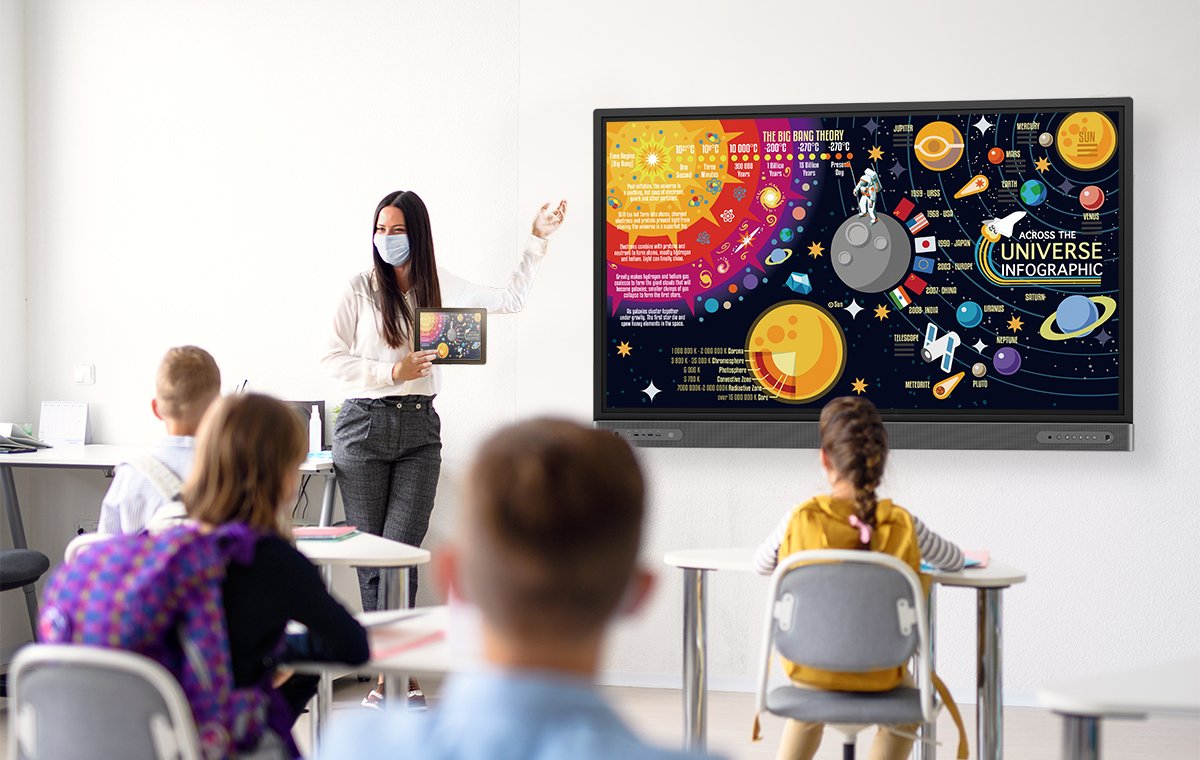
Walk into a classroom today and you may notice something very different from what classrooms looked like in the past. Instead of seeing only a chalkboard, textbooks, and notebooks, you might find interactive displays, tablets, computers, digital learning platforms, projectors, and even artificial intelligence tools.
Technology is changing the classroom in many ways. It is helping teachers present lessons differently, giving students more ways to participate, and making it easier to access information. The idea of a “smart classroom” is no longer something limited to futuristic schools. Technology is becoming an increasingly important part of everyday education.
What Is a Smart Classroom?
A smart classroom is a learning environment that uses digital technology to improve teaching and learning.
This can include interactive whiteboards, projectors, computers, tablets, educational software, internet-connected devices, digital textbooks, and other tools.
The goal isn’t simply to fill classrooms with expensive gadgets. The real purpose is to use technology to make lessons more engaging, understandable, and useful for students.
For example, instead of drawing a complicated diagram on a traditional board, a teacher can display an interactive model on a large screen and explain each part while students follow along.
Lessons Can Become More Interactive
One of the biggest advantages of smart classrooms is that lessons can become more interactive.
Traditional teaching often involves a teacher explaining a topic while students listen and take notes. That approach can still work, but technology provides additional ways for students to participate.
A teacher can display a quiz on an interactive screen and allow students to answer questions using tablets or computers. Videos, animations, simulations, and digital activities can also be included in lessons.
This can make students feel more involved instead of simply sitting and listening for an entire class.
Visual Learning Can Help Students Understand Difficult Ideas
Some subjects are difficult to understand through words alone.
Imagine trying to learn about the solar system using only a paragraph in a textbook. Reading about planets is useful, but seeing an animation showing how they move around the sun can make the concept much easier to understand.
The same applies to subjects such as biology, chemistry, geography, mathematics, and engineering.
Technology allows teachers to use images, videos, animations, diagrams, and simulations to explain ideas that may otherwise be difficult to visualize.
When students can see what they are learning, complicated concepts can sometimes become much easier to understand.
Students Can Access More Information
The internet has dramatically expanded the amount of information available to students.
In the past, students might have depended mainly on textbooks and whatever resources were available in their school library. Today, they can access digital libraries, educational websites, online courses, videos, research materials, and other resources.
This gives students opportunities to explore topics beyond what is covered in their classroom.
However, having access to a huge amount of information also creates a new responsibility. Students need to learn how to identify trustworthy sources and distinguish reliable information from misleading or inaccurate content.
Technology Can Support Different Learning Speeds
Not every student learns at the same speed.
In a traditional classroom, a teacher usually has to follow a schedule. Once a lesson is finished, the class moves on to the next topic.
Smart classroom technology can provide students with opportunities to review lessons at their own pace.
A student who is struggling with a particular topic can watch a recorded explanation again, complete additional exercises, or use digital learning materials for extra practice.
Meanwhile, students who understand the topic quickly can explore more advanced material.
This flexibility can help make education more personalized.
Teachers Can Track Student Progress
Technology can also help teachers understand how students are performing.
Digital learning platforms can sometimes show which questions students are getting wrong, how much time they spend on certain activities, and which topics require additional attention.
This information can help teachers identify areas where students may need more support.
For example, if many students perform poorly on the same section of a digital quiz, the teacher may realize that the topic needs to be explained again using a different approach.
Technology therefore doesn’t just change how lessons are delivered. It can also help teachers make better decisions about instruction.
Collaboration Becomes Easier
Smart classrooms can make it easier for students to work together.
Students can collaborate on digital presentations, shared documents, research projects, and group assignments. They can exchange ideas and work on projects without necessarily having to sit next to each other.
This is useful beyond school because collaboration is an important skill in many careers.
Modern workplaces often depend on digital communication and teamwork. Giving students experience with these tools can help prepare them for future professional environments.
Artificial Intelligence Is Entering the Classroom
Artificial intelligence is becoming another important part of educational technology.
AI can help students receive explanations, generate practice questions, brainstorm ideas, and explore difficult topics. Teachers can also use AI to help prepare lesson materials and create learning activities.
However, schools need to teach students how to use AI responsibly.
Students should not depend on AI to complete every assignment for them. The purpose of education is to develop knowledge and independent thinking, not simply to produce answers as quickly as possible.
AI works best as a supporting tool rather than a replacement for teachers or student effort.
Smart Classrooms Still Have Challenges
Although technology can provide many benefits, smart classrooms also come with challenges.
The first is cost. Computers, tablets, interactive displays, internet connections, software, and maintenance can be expensive. Schools with limited budgets may struggle to provide the same technology available in wealthier institutions.
Internet access can also be a problem. If the connection is unreliable, digital lessons can become frustrating for both teachers and students.
There is also the issue of distractions. Devices designed for learning can also provide access to games, social media, entertainment, and other activities.
Teachers therefore need clear rules and strategies for using technology effectively.
Teachers Remain Essential
One of the biggest misconceptions about smart classrooms is that technology will make teachers unnecessary.
Technology can provide information, but teaching involves much more than providing information.
Teachers encourage students, answer questions, understand individual needs, manage classroom discussions, and provide motivation. They also help students develop communication, creativity, confidence, and critical-thinking skills.
The best smart classrooms are not classrooms where technology replaces teachers. They are classrooms where teachers use technology to become more effective.
What Will Smart Classrooms Look Like in the Future?
The technology used in schools will likely continue to develop.
Students may increasingly use artificial intelligence, virtual reality, augmented reality, personalized learning platforms, and interactive simulations.
A history student might explore a virtual reconstruction of an ancient city. A medical student could practice procedures in a simulated environment. A science student might conduct a virtual experiment before working with real equipment.
These technologies could make education more immersive and practical.
However, schools will need to balance innovation with affordability, accessibility, privacy, and the importance of human interaction.
Final Thoughts
Smart classrooms are changing the way education is delivered. Technology gives teachers more tools for explaining lessons and gives students more opportunities to interact with information.
Interactive displays, educational apps, online resources, digital collaboration tools, and artificial intelligence can make learning more flexible and engaging.
But technology alone does not create a good education. A classroom filled with devices can still be ineffective if those devices are not used properly.
The real power of a smart classroom comes from combining useful technology with good teaching. When teachers know how to use digital tools effectively and students learn how to use them responsibly, technology can make the classroom more engaging, accessible, and prepared for the future.
