Introduction
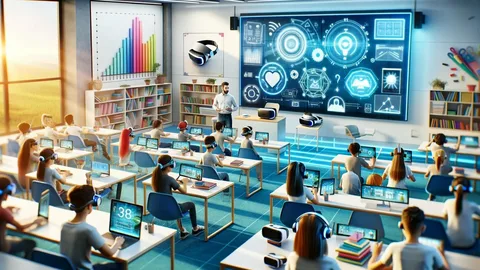
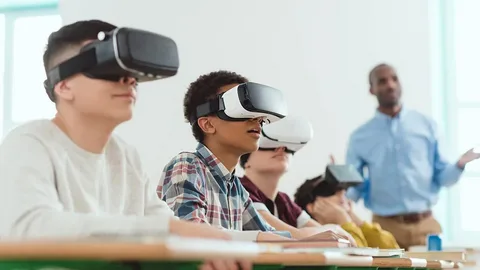
Technology has changed the way people learn, and one of the most exciting developments in education is virtual reality, commonly known as VR. Virtual reality is a technology that creates a computer-generated environment that users can explore and interact with. By wearing a VR headset, students can feel as if they are inside a different place or situation.
In the past, students mainly learned through textbooks, pictures, classroom discussions, and practical activities. These methods are still important, but virtual reality can provide students with experiences that may be difficult or impossible to create in an ordinary classroom. It can take students to historical places, outer space, laboratories, museums, and even inside the human body without requiring them to physically travel.
Making Learning More Interactive
One of the main benefits of virtual reality is that it makes learning more interactive. Instead of simply reading about a subject, students can experience it in a simulated environment.
For example, when learning about the solar system, students can use VR to explore planets and observe their positions. Instead of looking at a flat picture in a textbook, they can experience a three-dimensional representation.
This type of learning can make lessons more memorable. When students actively experience something, they may remember the information more easily than when they simply listen to a lecture.
Virtual Field Trips
Virtual reality can also provide students with virtual field trips. In a traditional classroom, taking students to another country, museum, historical site, or scientific facility can be expensive and difficult to organize.
VR can provide an alternative. Students can explore famous landmarks, historical locations, museums, or natural environments without leaving the classroom.
For example, a history class could take a virtual tour of an ancient civilization. A geography class could explore mountains, deserts, oceans, or other parts of the world.
This can make education more exciting while giving students experiences that may otherwise be unavailable to them.
Improving Science Education
Virtual reality can be particularly useful for science education. Some scientific concepts are difficult to understand because students cannot easily observe them directly.
VR can help students visualize things such as molecules, the human body’s organs, the movement of planets, or complex scientific processes.
Medical students can also use virtual simulations to learn about human anatomy and practice certain procedures in a controlled environment. While VR cannot completely replace real-world practical training, it can provide an additional opportunity for students to practice and build confidence.
Learning History Through Experience
History is another subject that can benefit from virtual reality. Students sometimes find history difficult because they are learning about events that happened many years ago.
VR can make historical topics feel more real. Students may be able to explore digital reconstructions of ancient cities, buildings, or historical environments.
For example, instead of simply reading about an ancient civilization, students could explore a virtual reconstruction and observe how people may have lived.
This does not replace textbooks or historical research, but it can help students develop a stronger connection with the subject.
Supporting Different Learning Styles
Students learn in different ways. Some prefer reading, while others learn better through images, demonstrations, or practical activities.
Virtual reality provides a visual and interactive approach that may be particularly useful for students who struggle with traditional teaching methods.
A student who finds it difficult to understand a concept through written explanations may understand it more easily after seeing and interacting with a three-dimensional simulation.
Increasing Student Engagement
Keeping students interested during lessons can sometimes be difficult. Long lectures and repetitive activities may cause students to lose concentration.
VR can increase engagement by giving students an opportunity to actively participate in the learning experience.
Instead of simply listening to a teacher describe an environment, students can explore it themselves. This sense of participation can encourage curiosity and make students more willing to learn.
Developing Practical Skills
Virtual reality can also help students develop practical skills. In some fields, students need to practice activities that may be expensive, dangerous, or difficult to perform repeatedly in real life.
VR simulations can provide a safe environment for practice. Students can make mistakes and try again without causing real-world damage.
For example, students studying engineering may use simulations to understand machines or industrial environments. Medical students may practice certain procedures in virtual environments before working with real patients.
This can improve confidence and allow students to learn from their mistakes.
Challenges of Virtual Reality
Despite its benefits, virtual reality has some disadvantages. The biggest challenge for many schools is cost. VR headsets and suitable computers can be expensive, especially for schools with limited resources.
There is also the issue of technical knowledge. Teachers need training to use VR effectively in their lessons. Simply having VR equipment does not guarantee better education. Teachers must know how to connect the technology to their learning objectives.
Some students may also experience discomfort when using VR headsets. Problems such as dizziness, headaches, or eye strain can occur for some users, particularly when the technology is used for long periods.
The Digital Divide
Another important concern is unequal access. Wealthier schools may be able to afford advanced VR equipment, while schools in poorer communities may not have access to basic technological resources.
If VR becomes a major part of education without addressing this inequality, some students could receive educational opportunities that others cannot access.
Governments and educational institutions therefore need to consider affordability and accessibility when introducing advanced technology into schools.
The Role of Teachers
Virtual reality should not replace teachers. Instead, it should be used as a tool to support teaching.
A teacher is still needed to explain concepts, guide students, ask questions, encourage discussion, and help learners understand what they experience in a virtual environment.
For example, students might explore a virtual historical site, but the teacher can then lead a discussion about the historical facts, evidence, and meaning behind what they observed.
The technology becomes most effective when it is combined with good teaching.
The Future of Virtual Reality in Education
As VR technology becomes more affordable and easier to use, it may become more common in schools and universities. Future students may have access to virtual laboratories, interactive museums, simulated workplaces, and other educational environments.
Virtual reality may also be combined with artificial intelligence to create more personalized learning experiences. Students could potentially interact with intelligent virtual tutors while exploring educational environments.
However, schools should introduce such technology carefully and ensure that it genuinely improves learning rather than simply being used because it is new.
Conclusion
Virtual reality has the potential to transform education by making learning more interactive, engaging, and practical. It can provide virtual field trips, support science and history lessons, help students develop practical skills, and give learners experiences that would be difficult to provide in an ordinary classroom.
At the same time, VR has challenges such as high costs, technical requirements, health concerns, and unequal access. Teachers also need proper training to use the technology effectively.
Virtual reality should therefore be viewed as a tool rather than a replacement for teachers or traditional educational methods. When used responsibly and combined with effective teaching, VR can give students exciting new ways to explore knowledge and understand the world around them.