Introduction
Artificial Intelligence (AI) is becoming an important part of modern society, and education is one of the areas being greatly influenced by this technology. Artificial intelligence refers to computer systems that can perform tasks that normally require human intelligence, such as learning, problem-solving, understanding language, and making decisions. In education, AI is being used in classrooms, online learning platforms, examinations, research, and administrative activities. As technology continues to develop, artificial intelligence has the potential to change how students learn and how teachers teach.
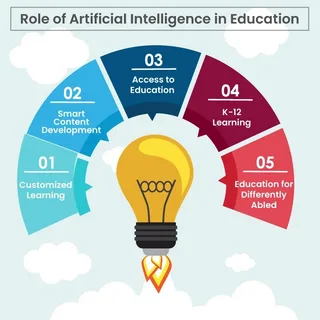
One major advantage of AI in education is that it can provide personalized learning. Students have different abilities, interests, learning speeds, and educational needs. In a traditional classroom, one teacher may have to teach many students at the same time, making it difficult to give every learner individual attention. AI-powered educational systems can analyze a student’s performance and identify areas where the student is struggling. The system can then recommend suitable exercises, explanations, or learning materials. This can help students learn at a pace that is appropriate for them.
AI as a Learning Assistant
Artificial intelligence can also act as a learning assistant for students. AI-powered tools can answer questions, explain difficult concepts, summarize information, and provide examples. Students can use these tools when studying mathematics, science, languages, history, and other subjects. For example, a student who does not understand a mathematical problem can receive a step-by-step explanation.
AI can also help students improve their writing. Some AI tools can identify grammatical errors, suggest improvements, and help learners organize their ideas. This can be useful for students who are developing their communication skills. However, students should use AI as a learning aid rather than allowing it to do all their work. Education should develop independent thinking, creativity, and problem-solving abilities.
Benefits for Teachers
AI is not only useful to students; it can also assist teachers. Teachers spend considerable time preparing lessons, creating questions, marking assignments, recording grades, and performing administrative tasks. Some of these activities can be supported by artificial intelligence.
For example, AI systems can help teachers create quizzes and learning activities based on a particular subject. They can also assist with analyzing student performance. If many students perform poorly on a particular topic, the teacher may realize that the topic needs to be explained again.
By reducing some administrative responsibilities, AI can allow teachers to spend more time interacting with students. Teachers can focus on activities that require human qualities such as encouragement, emotional support, creativity, leadership, and understanding.
Online and Remote Education
Artificial intelligence is also transforming online education. Many students now use digital platforms to study from home or from locations far away from traditional schools. AI can make these platforms more effective by recommending learning materials based on students’ previous activities and performance.
AI-powered systems can provide immediate feedback. Instead of waiting several days for a teacher to mark an assignment, students may receive instant information about their mistakes. Immediate feedback can help learners identify problems while the lesson is still fresh in their minds.
This technology may be especially valuable for students who do not have easy access to high-quality educational resources. However, access to reliable electricity, internet services, computers, and smartphones remains a challenge in many developing communities.
AI and Special Education
Another important application of AI is in special education. Students with disabilities may require different methods of learning. Artificial intelligence can support accessibility through tools such as speech recognition, text-to-speech systems, automated captions, and other assistive technologies.
For example, a student with difficulty reading may use technology that reads digital text aloud. A student with hearing difficulties may benefit from automatic captions during online lessons. These technologies can make educational materials more accessible and inclusive.
Challenges and Risks
Despite its advantages, artificial intelligence also creates several challenges. One major concern is academic dishonesty. Students may use AI to write essays, answer examination questions, or complete assignments without actually learning the material. If students depend too heavily on AI, they may lose opportunities to develop their own reasoning and writing abilities.
Another concern is inaccurate information. AI systems can sometimes provide incorrect or misleading answers. Students therefore need to learn how to verify information rather than automatically believing everything generated by an AI system.
Privacy is another important issue. Educational technology may collect information about students, including their academic performance and learning behavior. Schools and technology providers must ensure that student information is protected and used responsibly.
There is also the issue of inequality. Wealthier schools may have access to advanced AI technologies, while schools in poorer communities may lack computers, internet connections, or trained teachers. If these differences are not addressed, technology could increase the educational gap rather than reduce it.
The Changing Role of Teachers
The development of AI does not necessarily mean that teachers will become unnecessary. Instead, the role of teachers may change. Teachers will continue to provide guidance, motivation, emotional support, and human interaction.
A computer can explain a concept, but a teacher can understand when a student is frustrated, confused, or losing confidence. Teachers can also encourage teamwork, discussion, creativity, and moral development. These human qualities are extremely important in education.
Therefore, the most effective educational system is likely to combine artificial intelligence with human teaching. AI can handle certain repetitive tasks and provide personalized support, while teachers provide direction and human understanding.
The Future of AI in Education
The future of artificial intelligence in education is likely to involve even greater use of intelligent learning systems. Students may have access to personalized digital tutors that adapt to their individual needs. Schools may use AI to identify students who need additional support before they fall significantly behind.
AI may also help institutions analyze large amounts of educational data and improve decision-making. However, schools must establish clear rules for responsible AI use. Teachers and students should be trained to understand both the benefits and limitations of the technology.
Conclusion
Artificial intelligence is changing education by providing personalized learning, supporting teachers, improving online education, and increasing accessibility. It offers many opportunities to make learning more flexible and effective. At the same time, challenges such as academic dishonesty, privacy concerns, inaccurate information, and unequal access must be addressed.
The goal should not be to replace teachers with machines. Instead, AI should be used as a tool that supports teachers and helps students learn more effectively. When combined with good teaching, responsible policies, and equal access to technology, artificial intelligence can make a significant contribution to the future of education.