Introduction
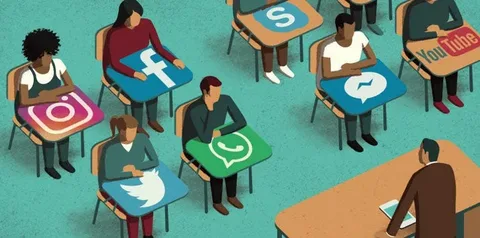
Social media has become a major part of modern life. Platforms such as Facebook, WhatsApp, Instagram, YouTube, TikTok, and other online communities are used by millions of people every day to communicate, share information, and interact with others. Although social media is often associated with entertainment and social relationships, it can also play an important role in education.
Students and teachers can use social media to share learning materials, communicate about school activities, discuss ideas, and discover educational content. However, social media can also create distractions and other problems when it is not used responsibly. Therefore, understanding both its benefits and disadvantages is important.
Communication Between Students and Teachers
One of the most useful roles of social media in education is improving communication. Teachers can create online groups where they communicate with students about assignments, tests, projects, and other school activities.
For example, a teacher can use a messaging group to remind students about an upcoming examination or share additional materials related to a lesson. Students can also ask questions when they do not understand something.
This can make communication faster and more convenient. Students do not always have to wait until the next classroom lesson to ask a simple question or receive important information.
Sharing Educational Materials
Social media makes it easy to share educational resources. Teachers can send documents, videos, photographs, links, presentations, and other materials to their students.
Students can also share useful resources with one another. A student who finds an interesting educational video, article, or explanation can share it with classmates.
This encourages students to learn from one another rather than depending entirely on the teacher. It can also expose learners to different explanations of the same topic.
Educational Videos and Content
Social media platforms contain a large amount of educational content. YouTube, for example, has videos explaining mathematics, science, history, languages, technology, and many other subjects.
Students sometimes understand a difficult topic better after watching someone explain it visually. A video can demonstrate an experiment, explain a mathematical process, or show how a particular piece of technology works.
Short educational videos on social media can also introduce students to new ideas. However, students need to be careful because not every educational-looking video contains accurate information.
Encouraging Collaboration
Social media can encourage students to work together. Students can create online groups to discuss assignments, exchange ideas, and work on projects.
For example, students working on a group presentation can communicate online without having to meet physically every time. They can share ideas, divide responsibilities, and review each other’s work.
This type of collaboration can help students develop communication and teamwork skills. These skills are valuable not only in school but also in future workplaces.
Connecting Students With the Wider World
Social media can expose students to people, cultures, and ideas from different parts of the world. A student in Nigeria, for example, can follow educational communities created by teachers or students in other countries.
This can broaden students’ understanding of global issues and different ways of thinking. It can also help learners discover opportunities such as scholarships, competitions, online courses, educational events, and career information.
In this way, social media can make education less limited by geographical boundaries.
Supporting Teachers
Social media can also benefit teachers. Teachers can join professional communities where they exchange teaching ideas, lesson plans, classroom experiences, and educational resources.
A teacher who is struggling to teach a particular topic can learn about different teaching methods from other educators. This can encourage professional development and creativity.
Teachers can also use social media to discover new educational technologies and stay informed about developments in their subjects.
Social Media as a Source of Motivation
Social media can motivate students when it is used positively. Students may follow successful professionals, educational organizations, scientists, authors, entrepreneurs, or other inspiring individuals.
Seeing people share their experiences and achievements can encourage young learners to take their education seriously and think about their future goals.
Educational challenges and online study communities can also encourage students to maintain regular study habits.
Negative Effects and Distractions
Despite its benefits, social media can negatively affect education. One of the biggest problems is distraction. A student may open a phone to search for educational information and quickly become distracted by entertainment videos, messages, or other social media content.
This can reduce concentration and waste valuable study time. Students may also develop habits of constantly checking notifications instead of focusing on their schoolwork.
Social media can also affect sleep when students spend long periods online at night. Lack of sleep can make it difficult for students to concentrate and perform well academically.
Misinformation and Unreliable Information
Another major concern is misinformation. Anyone can post information on many social media platforms, regardless of whether they are an expert on the subject.
Students may therefore come across incorrect information and believe it is true. This is especially dangerous when students use social media as their only source for school assignments.
Students should learn to check information against reliable sources such as textbooks, educational institutions, academic publications, and trusted websites. Developing critical-thinking skills is essential in the digital age.
Cyberbullying and Online Safety
Social media can also expose students to cyberbullying. Cyberbullying occurs when someone uses digital platforms to threaten, insult, embarrass, or harass another person.
Such experiences can negatively affect a student’s confidence, emotional well-being, and ability to concentrate on schoolwork.
Students should therefore be taught about online safety and responsible digital behavior. They should know how to protect their personal information, recognize harmful behavior, block or report abusive accounts, and seek help from trusted adults when necessary.
Conclusion
Social media has an important role to play in modern education. It can improve communication between teachers and students, make educational materials easier to share, support collaboration, provide access to educational videos, and connect students with people and opportunities around the world.
However, social media also has disadvantages. Distractions, misinformation, cyberbullying, excessive screen time, and privacy concerns can interfere with learning if the platforms are used carelessly.
The solution is not necessarily to completely remove social media from education. Instead, students should be taught how to use it responsibly and productively. Teachers and parents can guide students toward educational content while helping them avoid harmful or distracting activities.
When used wisely, social media can be more than a source of entertainment. It can become a useful educational tool that helps students communicate, collaborate, discover information, and develop skills that will be valuable in the modern world.